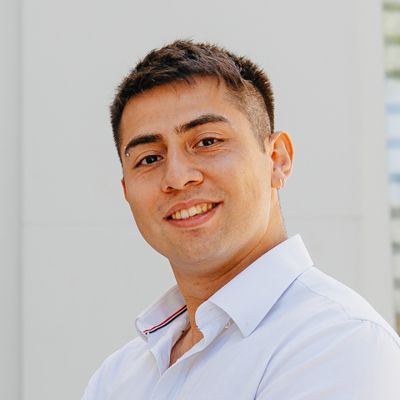
I am a software engineer and researcher with a biomedical engineering background. I build full-stack systems and data pipelines for institutions that can't afford a mistake, and I check their output with numbers instead of by eye.
My research was on brain connectivity: clustering about a million white-matter fiber centroids from 100 people on modest hardware. My engineering work is in public-sector purchasing, where I first worked inside Chilean hospitals and now build the software for it.
Today I am CTO and co-founder of Next Core Revolution.
What I do
Software engineering
Full-stack products and system integration: Django and PostgreSQL, React and TypeScript, REST APIs, single sign-on and electronic signature, deployed with Docker, Nginx, Redis and Celery on-premise or on Google Cloud.
Research and data
Pipelines for large, noisy scientific data in Python and C++, with every stage measured. My focus was diffusion MRI and brain connectivity.
Applied AI
Retrieval-augmented generation with Gemini and semantic search over pgvector in production software, LLM agents, and unsupervised learning at scale in my research.
Background
I am a Biomedical Civil Engineer (2019-2025). My path has three parts: clinical engineering and purchasing in Chilean public hospitals, brain connectivity research, and software for institutional purchasing and contracts. In hospitals I learned how institutional purchasing really works and where it fails: buying isn't hard, proving you bought correctly is. In research I learned to build pipelines for large, messy data and to check their output against something outside the pipeline.
Experience
| Period | Role | What I did |
|---|---|---|
| 2023 - today | CTO and co-founder, Next Core Revolution | Architecture, engineering and deployment of institutional software (see Next Core Revolution). |
| Sep 2025 - Feb 2026 | Engineer, Medical Equipment Unit, Hospital del Salvador | Tender documents, bid evaluation and support in maintaining high-complexity medical equipment. |
| Jul - Aug 2025 | Engineer, Medical Equipment Unit, Hospital Herminda Martín (Chillán) | Technical specifications, inventory, administration of maintenance agreements for the regional hospital, and manufacturer training in CT, 1.5 T MRI, C-arm and X-ray diagnostics. |
| Apr 2025 | Engineer, Medical Equipment Unit, Hospital del Salvador | Fast-track purchases, evaluation of technical specifications and inventory. |
| Mar 2024 - Mar 2025 | Collaborating researcher, FONDECYT Regular 1221665 | Multiscale brain parcellation from diffusion MRI tractography in Python and C++, 3D visualization with VTK and OpenGL, and quantitative comparison with reference atlases. |
| Mar - Dec 2023 | Teaching assistant | Digital medical image processing and programming: content, classes and assessment material. |
| Jan - Mar 2023 | Clinical engineering intern, Hospital Dr. Benicio Arzola Medina (San Carlos) | Installation, maintenance and calibration of clinical equipment, and support in tenders, agreements and staff training. |
I also completed an online course on preventing and controlling multidrug-resistant infections in hospitals (Pan American Health Organization, April 2025).
Technical profile
- Languages: Python, JavaScript and TypeScript, Java, C++, Bash, SQL. Spanish native, English advanced.
- Back end and data: Django, layered architecture, REST APIs, JWT and OIDC, fine-grained role-based access control, PostgreSQL with pgvector, SQL Server (T-SQL), Redis, Celery, schemas versioned by period.
- Integration: paginated REST APIs with token authentication, government and academic systems, normalizing data from several institutional sources, electronic signature, web scraping with Playwright.
- Front end: React and TypeScript.
- Infrastructure: Linux server administration over SSH, Docker Compose, Nginx, CI/CD, Git, on-premise deployment and Google Cloud (Cloud Run, Cloud SQL, Cloud Storage).
- Security and compliance: HTTPS and TLS, server hardening, OWASP practices, audit logs by user and date, and applied knowledge of Chilean data-protection law (Law 19.628 and the new Law 21.719).
- AI and machine learning: retrieval-augmented generation, LLM agents, embeddings and semantic search, and unsupervised clustering (FFClust, QuickBundles) on millions of data points.
- Research methods: diffusion MRI tractography, cortical surface meshes, 3D visualization, quantitative comparison against published atlases.
Selected work
Thesis: brain parcellation
A pipeline that clusters white-matter fibers from 100 Human Connectome Project subjects and turns them into a 328-region cortical parcellation, on a decade-old workstation.
Methodology and results →Next Core Revolution
CTO and co-founder of a startup building procurement software that runs on an institution's own rulebook.
My role →Hospital warehouse inventory system
In two weeks I catalogued every item in a public hospital's medical equipment warehouse, gave each spare part a unique key and a QR code, and arranged the stock by category so stock-outs could be flagged. Traceable stock rose 80%, leaving out spares that cannot be tracked. I worked with the warehouse manager so the people who use the warehouse adopted it.